
Center for Coastal & Marine Studies
HAPPY BIRTHDAY TO US: CCMS TURNS 8!

On 9 March 2026, we celebrate the 8th anniversary of the Center for Coastal and Marine Studies (CCMS)! Over the past eight years, CCMS has grown through dedication, collaboration, challenges, achievements, and continuous learning. It has been an inspiring journey so far, and we are proud of all that we have accomplished together. As we now enter Year Nine, we look ahead with confidence, ambition, and excitement for what lies ahead.
Since its establishment, CCMS has been driven by the mission to advance and promote science, research, knowledge transfer, and innovation in the Black Sea region and the World Ocean. By bringing together science, environment, expertise, stakeholders, and policy making, the CCMS has worked to strengthen the scientific foundation for sustainable coastal and marine development. Our activities cover a wide spectrum of coastal and marine research, including studies and surveys on modern coastal and marine processes, while also supporting the implementation of major European coastal and maritime Strategies and Directives, such as Maritime Spatial Planning, the Blue and Circular Economy, the European Green Deal, and the EU Mission: Restore our Ocean and Waters.
An important source of strength for CCMS is the guidance of its Advisory Committee, which includes seventeen distinguished scientists and experts from institutes, universities, and organizations across the globe, including Australia, Belgium, Colombia, Estonia, Germany, Greece, Italy, Poland, Romania, Spain, Turkey, the United Kingdom, the United States, and Bulgaria. Their expertise, encouragement, and commitment have played a vital role in the Center's development and achievements. More information about the Advisory Committee members can be found here: Advisory Committee!
Systematic, connected: building the future of Europe’s marine protection
BLUE CONNECT is creating a blueprint to guide science-based protection, co-management and monitoring of Europe’s seas
Europe has set ambitious targets for protecting its marine environment, but progress reveals a significant gap. Only 13.7% of EU seas are protected, and just 0.03% are strictly protected – far below the EU Biodiversity Strategy’s 2030 goals of 30% and 10%, respectively. Meeting these targets requires not only designating new Marine Protected Areas (MPAs) but also strengthening existing ones and ensuring they form an effective, connected network.
BLUE CONNECT, a Horizon Europe Mission Ocean project, supports Europe in closing this gap. It promotes a comprehensive, science-driven and inclusive approach to expanding existing or designating new MPAs, shifting to strict protection, enhancing ecological connectivity, and facilitating co-management with local stakeholders. The project aligns with Mission Ocean and Waters objectives, providing Europe with tools to meet its 2030 protection and restoration commitments.
A science-driven blueprint
BLUE CONNECT aims to develop and implement a systematic approach to effective marine conservation. Central to this approach is a holistic modelling framework that considers biodiversity, ecological functioning, ecosystem services and connectivity aspects as well as socio-economic and cultural interests.
BLUE CONNECT joined the #30DayMapChallenge with a Burgas Bay (Black Sea)-themed map
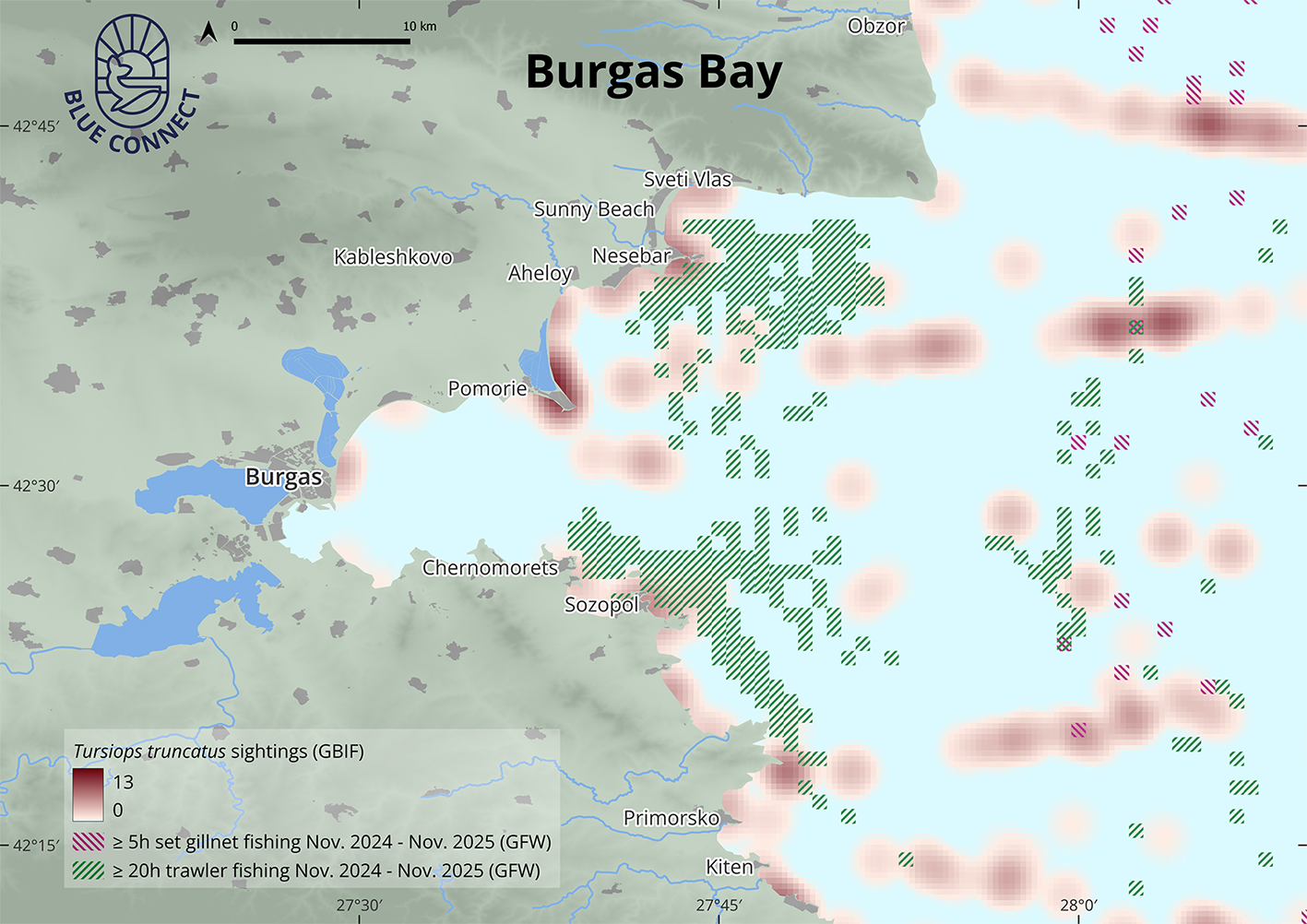
As part of this year’s #30DayMapChallenge, the BLUE CONNECT Project has highlighted one of its 12 Demonstration Sites - Burgas Bay, Black Sea and its marine biodiversity with a new map demonstrating the spatial overlap between fishing activities and the Black Sea bottlenose dolphins (Tursiops Truncatus) in the Bulgarian sea waters. The 30 day map challenge is a yearly event each November in which participants aim to make a different map every day according to a set of themes and share them on social media with the hashtag #30DayMapChallenge.
Created by our colleague Lawrence Whatley from VLIZ, the map visualises areas where trawling and set gillnet fishing – identified as key pressures – intersect with recorded sightings of bottlenose dolphins. In Burgas Bay, marine mammals including the Black Sea bottlenose dolphin (Tursiops Truncatus) have been identified as important ecological subjects, and fishing, particularly trawling and gillnet fishing, as a significant pressure. By overlaying data from GBIF: The Global Biodiversity Information Facility and Global Fishing Watch, the hot spot areas of impact are visualized to help inform conservation and restoration measures. The map shows sightings of bottlenose dolphins and areas where at least 5 hours of set gillnet fishing and/or 20 hours of trawling have happened in the last year.
ULTFARMS CAPITALISATION WORKSHOP: SCALING SUSTAINABLE OFFSHORE SOLUTIONS
The CCMS Director Dr. Margarita Stancheva was invited speaker at an interactive Blue Economy Roundtable of the ULTFARMS Capitalisation Workshop.

On 5th of November 2025, the Technological Corporation of Andalusia (CTA) in representation of the ULTFARMS project hosted the Capitalisation Workshop, which aimed to advance low-trophic aquaculture development in offshore wind farms and accelerate its commercial deployment. The workshop brought together stakeholders from across the blue economy, research, and investment sectors and included interactive online sessions designed to accelerate the transfer and scaling of innovative solutions for offshore multi-use farming.
The workshop opened with an introduction to its objectives and expected outcomes, followed by a showcasing of the project pilots, highlighting innovative approaches, key achievements, and lessons learned across different European contexts. The following dedicated Capitalisation Session served as a platform to identify synergies, share cross-pilot insights, and address common challenges, while exploring how innovative solutions can be adapted and transferred across regions and sectors.
The event culminated in a Blue Economy Roundtable, bringing together pilot leaders, researchers and investors to explore opportunities and risks, creative financing mechanisms, and pathways to scale promising multi-use offshore solutions.